Showing 1–12 of 34 results

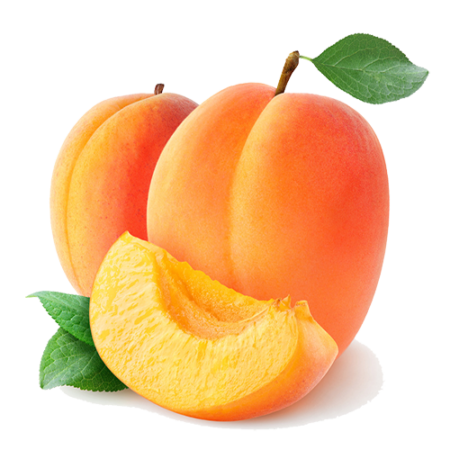
Apricot
Read moreThe apricot is a small tree, 8–12 m (26–39 ft) tall, with a trunk up to 40 cm (16 in) in diameter and a dense, spreading canopy. The leaves are ovate, 5–9 cm (2.0–3.5 in) long, and 4–8 cm (1.6–3.1 in) wide, with a rounded base, a pointed tip, and a finely serrated margin. The flowers are 2–4.5 cm (0.8–1.8 in) in diameter, with five white to pinkish petals; they are produced singly or in pairs in early spring before the leaves. The fruit is a drupe similar to a small peach, 1.5–2.5 cm (0.6–1.0 in) diameter (larger in some modern cultivars), from yellow to orange, often tinged red on the side most exposed to the sun; its surface can be smooth (botanically described as: glabrous) or velvety with very short hairs (botanically: pubescent). The flesh is usually firm and not very juicy. Its taste can range from sweet to tart. The single seed is enclosed in a hard, stony shell, often called a “stone” or “kernel”, with a grainy, smooth texture except for three ridges running down one side.
Banana
Read moreThe banana plant is the largest herbaceous flowering plant.[8] All the above-ground parts of a banana plant grow from a structure usually called a “corm”.[9] Plants are normally tall and fairly sturdy, and are often mistaken for trees, but what appears to be a trunk is actually a “false stem” or pseudostem. Bananas grow in a wide variety of soils, as long as the soil is at least 60 centimetres (2.0 ft) deep, has good drainage and is not compacted.[10] The leaves of banana plants are composed of a “stalk” (petiole) and a blade (lamina). The base of the petiole widens to form a sheath; the tightly packed sheaths make up the pseudostem, which is all that supports the plant. The edges of the sheath meet when it is first produced, making it tubular. As new growth occurs in the centre of the pseudostem the edges are forced apart.[11] Cultivated banana plants vary in height depending on the variety and growing conditions. Most are around 5 m (16 ft) tall, with a range from ‘Dwarf Cavendish’ plants at around 3 m (10 ft) to ‘Gros Michel’ at 7 m (23 ft) or more.[12][13] Leaves are spirally arranged and may grow 2.7 metres (8.9 ft) long and 60 cm (2.0 ft) wide.[1] They are easily torn by the wind, resulting in the familiar frond look.
Blueberry
Read moreFive species of blueberries grow wild in Canada, including Vaccinium myrtilloides, Vaccinium angustifolium, and Vaccinium corymbosum which grow on forest floors or near swamps.[6] Wild (lowbush) blueberries are not planted by farmers, but rather are managed on berry fields called “barrens”.
Cherries
Read moreProduct Description
Obviously cherry is most used for cooking and consuming. The species originate in Europe and western Asia and in West Asia (Middle East). Major commercial cherry orchards in West Asia are in Turkey, Iran, Syria, Azerbaijan, Lebanon, and Israel and we are providing the product of defined specialist countries. In the exporting process, our partners are Russia and other European countries.
GROWERS Varieties
Turkey Sour cherry
Azerbaijan Sweet cherry
Greece Black cherry
Argentina Black Pearl
Spain Rainier
Van
Feijoa
Read moreThe feijoa is the fruit of Acca sellowiana, an evergreen shrub or small tree, 1–7 m in height. It comes from the highlands of southern Brazil, parts of Colombia, Uruguay, Paraguay and northern Argentina. They are also grown throughout Azerbaijan , Iran (Ramsar), Georgia, Russia (Sochi), New Zealand and Tasmania Australia .